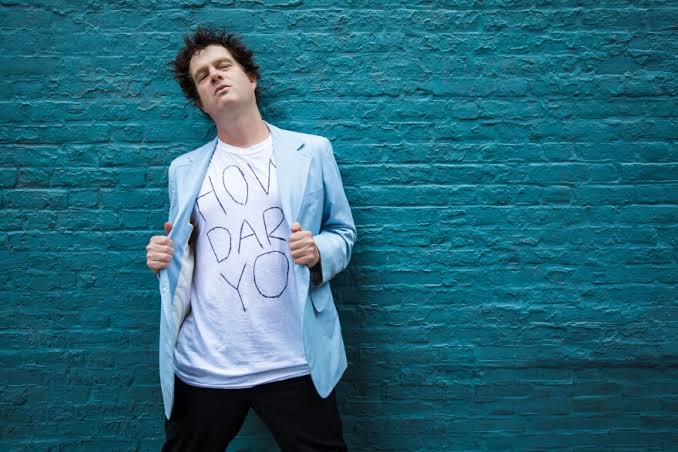
Electric Six has been described many ways — disco, punk, new wave, dance, metal, novelty, alternative — but there’s one word everyone can agree on: prolific.
A six-man outfit (appropriate) from Detroit, Electric Six has pumped out seven albums since its breakthrough debut Fire in 2003, leaving a case full of catchy songs and hilarious lyrics in its wake. Dick Valentine (aka Tyler Spencer) is the band’s lead singer and primary songwriter, and despite being the sole remaining member since those Fire days, finds E6 in a good place.
With the September release of Zodiac (a 12-song opus with lyrics that include “Stop! We are good times/I am god’s love, baby/I’m Courtney Love, baby/Who the hell are you?”) and a worldwide tour which brings the band through Atlanta, Valentine is getting ready the only way he knows how: By chopping wood.
He also sat down to discuss his love for a certain political family, his Seinfeld-type writing style, and mass murderers.
So how’s it going today?
DV: I’m actually in a cabin in Vermont. I do a lot of heavy lifting, split logs, put on flannel, grow a beard, then I bounce right back from that then I’m on stage for the next seven weeks.
Do you shed the beard before you go back onstage?
DV: Exactly, I’m clean-shaven because I want to be president of the United States and I’m going on the theory that you have to be clean-shaven if you want to be president
Abraham Lincoln was not clean-shaven, but then again he was assassinated.
DV: This is a 20th Century theory, since about Woodrow Wilson, Calvin Coolidge on there’s been no facial hair on our presidents
That’s true. I remember when Al Gore was talked about becoming a candidate once again and he grew a beard and then people said “there’s no way he could be a candidate again.”
DV: Oh yeah, there was no way he could do it again. I’m a big Bush guy anyway, I’m looking for Jeb Bush this time and after Jeb Bush we want Marvin Bush, and after that we want more and more Bushes, because you know what you get.
I used to live in Florida when Jeb was the governor. You know he speaks Spanish?
DV: The Bushes just make you feel better about yourself, they speak for all of us. I want more and more Bushes. So that’s it, I’m not gonna have facial hair and I’m going to transform myself into a Bush, I’m ready to go.
I think you can do it. You could try and fake your way into becoming a Bush, there’s so many of them they might not know.
DV: That’s right, I’m in New England right now and I’m only a stone’s throw away from Kennebunkport. They’ll never know.
I was looking online the other day and I saw these YouTube videos for songs from the new album, and I know you said you weren’t going to do videos anymore. Do you ever see those videos other people do for your songs?
DV: All the time. We have a lot of free time on the road, and between the six of us someone always finds something. It’s stupid to pretend that you don’t Google yourself, of course you Google yourself. Some of them are good and some of them are bad, you just try to act like a neutral third party. We’re Libertarian when it comes to YouTube we just let the free market dictate what’s going to be up there and we don’t throw out opinions or comments
Have you seen the one for “Rubberband Man”?
DV: Where the guy took the old footage of Spinners? It’s ’cause we stayed true to the original tempo of the song and the original feel of the song. It was well done. I love the way those guys in the Spinners look.
You said that was one of the catchiest songs you’ve ever heard and one you wanted to cover. Why that song?
DV: The mud wrestling scene in Stripes when John Candy says he a mean, lean fighting machine, that’s the song in the background and I remember it being so catchy. I associate it with a kind of self-confidence and he was going to wrestle those girls and it was in a pit of mud.
Was it a coincidence that they were from Detroit as well?
DV: I think it is. We don’t really pay attention to where bands are from, and if bands are from Detroit we try not to cover them, this was the exception.
Does being from Detroit identify your band at all?
DV: Yes and no. We’ve never fit in with a lot of things about Detroit the whole MC5, Stooges kind of thing was never our cup of tea, but that having been said, I don’t know if we could have existed as an unsigned, unprofitable band as long as we did if we were from another town. If we were from New York or L.A. we would have gotten tired of it really quick, whereas in Detroit there’s such as a supportive local scene and it allowed us to keep going while we weren’t making money.
Your new album is called Zodiac, it has 12 songs on it, is that a coincidence?
DV: That is not a coincidence. That was an idea to keep the amount of songs on the album down to a minimum so we wouldn’t have to mix or match more songs. We usually record 17 or 18 songs and sometimes you say “let’s put 16 songs on the record” but that leaves to more work. But if you name the record Zodiac, you know you just have to have 12 songs. It makes it a bit easier for everyone.
Maybe I’m just a bit macabre, cause your previous album is KILL and this one’s called Zodiac, I thought you were going for a Zodiac killer vibe.
DV: No, it’s all coincidence. I thought about on the album having the first words on every song lead to a secret message, but really once we’re done touring for an album we don’t think about it or its effect on future albums ever again.
So the next album will not be called Ted Bundy?
DV: Kill, Zodiac, Ted Bundy — no, but I think now that you mention it maybe consciously we’ll call it Bright and Happy, maybe that’s the way to go, cause we certainly don’t want to get pigeon-holed as one of those murder bands
No, you don’t want to do that. But I always thought it would be interesting to open a restaurant where the menu was the last food ordered by mass murderers on death row. You could get the John Wayne Gacy, which I think was four hamburgers.
DV: I remember Tim McVeigh’s last meal was two pints of mint chocolate chip ice cream, and the reason I know that is I was driving to work and there was the funny morning show shock jocks — those funny guys who aren’t really funny — and the guys said “So Tim McVeigh had his last meal and it turns out it was two pints of mint chocolate chip ice cream. Not only is he a sadistic killer but he’s also an idiot.” That was the joke (fake laugh). There’s lots of people who are fascinated by killers, but I’m not one of them. It is getting harder and harder to open a restaurant, that might work. You need something.
You’ve said you write songs about nothing. How do you write a song about nothing?
DV: It’s very easy. You just clear your mind. It’s like swimming laps in a pool as long as you don’t realize that you’re running out of oxygen you’re able to stay focused on getting to the end of the pool, it’s like that with songs. As long as you realize that you have a limited amount of oxygen you’ll be fine.
So if you stumble across a song and you realize “I’m writing a song about something” do you stop and, I guess, breathe?
DV: I do, as a matter of fact. I intentional try not to write about a person I ever met. I try to make the lyrics as abstract and not be about anything because I’m well immersed in my real life and I don’t need any more reminders about any portion of that. I’m very happy with experiencing my real life outside of the dream world
So your albums are like versions of Seinfeld?
DV: Exactly
I think you have something there, because Seinfeld was tremendously popular
DV: (Laughs) Right now we’re entering our Michael Richards phase.
You guys are rather prolific when it comes to putting out albums. Do you just have a flood of songs going back and forth in your head?
DV: I do.
Do you have the next album written in your head?
DV: No, but we have ideas. On this album we have a song called “Clusterfuck” which has been in my head for six years now, the chorus for “Clusterfuck” has been there a long time. Maybe when you’re doing an album like Flashy maybe you have 12 songs that aren’t “Clusterfuck” and that works where you get to a point where now is the time I’ll finally get this idea out of my head. I always have a backlog of ideas, ideas that could have been on the third album but maybe they’ll be on our eighth album. It’s my lot in life.
Is the writing process for you a lyric, or a hook?
DV: I have lyrics floating around I have riffs floating around and the other people in the band write as well. The first song on Zodiac, “After Hours” was 100 percent our bass player and all I had to do was come up with the words that fit. Between the six of us in the band we never run out ideas.
So you go from tour to studio, tour to studio?
DV: We have for the last five or six years. I think we all appreciate the situation we have and this is our job and we also feel like if we slow down or take a break it will all be taken away from us. I don’t know if that’s true or not, but as long as we feel that way then we’ll continue putting out albums.
Is that a feeling because the music industry is the way it is, that you have to keep swimming to stay alive?
DV: I think so. I can’t speak for other bands but for us we have stumbled across this formula where we have a label that encourages us to put out an album a year, they don’t meddle in what’s going to be on it, they just want an album and there’s a reliable fan base of people who will buy the records and keep us out on tour. I think until we absolutely get sick of it, which we’re nowhere close to yet, we’ll keep going.
It’s nice to have a fan base that like what you do and a record label that gives you the freedom to write what you want.
DV: We had that great success for a year in the UK and got to do it a different level where maybe you’re in more magazines and on TV and people treat you differently and then you fall pretty hard from that. It gave us perspective. I have seen so many bands break up when they go down because they think they’re embarrassed, but we never saw it that way, we looked at it like we had a foot in the door. I’m much happier with where the band is at now that I was in 2003.
But that success in 2003 allows you to be here in 2010.
DV: Exactly. We always looked at it as what can you do yourself and what are you left with, maybe we can’t do this, maybe we can do this and it lets us concentrate on what we can control. There’s not exact science to it, and you can’t say it will work for every band but as long as we kept touring and putting out music we had something that work.
I am a child of the ’80s, and a couple of months back I saw Cy Curnin, who was the lead singer of The Fixx, play and after singing One Thing Leads to Another, he said “that’s the mortgage song that allows me to keep doing this.”
DV: (Laughs) Yeah, a lot of the songs from our first album get used. We got our record deal and our case of professionalism in our early 30s and now we’re in our late 30s you have more perspective than if you were a 21-year-old. People get upset if they have to play the same song over and over again but we don’t because if the worst thing you have to do is play “Gay Bar” every night, then that’s a pretty good life. It’s not torture, it’s not hell. People ask “It must be hell to play Gay Bar.” It’s not, not at all.