This was written in March 1990 for my college newspaper.
Sinead O’Connor is a walking billboard of kindness and arrogance.
Her voice coos with breezy undertones of subtlety, while her lyrics scream with passionate warnings of awareness. It is this that allows O’Connor to avoid the dreaded record business “sophomore slump” that has taken down such overnight phenoms as the BoDeans and the Violent Femmes.
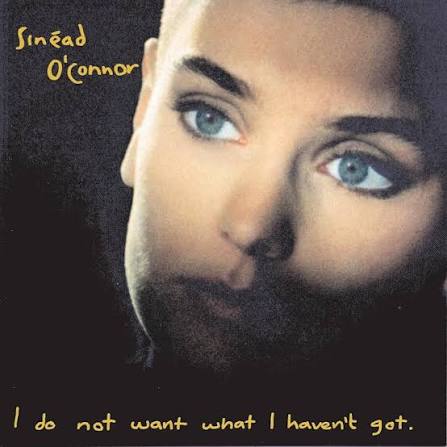
With her second offering, “I do not want what I haven’t got,” O’Connor bas closed the gaps left open in her 1988 release,“The Lion and the Cobra,” and created an album that in its jerkiness is wholly symbiotic.
She goes from song to song, creating a new pattern with each bar, each note. Sometimes the song is melodic and hypnotizing, while at other times the song enjoys a repetitive beat-box aura throughout.
O’Connor worked with this on her first album, but in this album it doesn’t seem as forced, almost unintentionally. How good can O’Connor be? Her first single off the album, “Nothing Compares 2 U,” a song written by Prince, has transcended all radio station boundaries and is being played by everyone. And it’s not the music that causes the universal appeal, it is the voice.
If you can’t hear it, you must see it. The video opens with a tight shot of O’Connor, and slowly as the music pumps in, O’Connor quietly rages, “It’s been seven hours and 15 days/Since you took your love away.” By the end of the five-minute clip, O’Connor is crying. It’s not acting, it’s sincerity, and it is overwhelming. The song is powerfully sad. It is about loss, rejection and a hope for a reunion that will never happen. It may be one of the best songs to ever come out because of what it does to a listening audience.
But O’Connor doesn’t bank her reputation on the one song, she surrounds the masterpiece with equally powerful gems.
The opening track, “Feel so Different,” is a slow piece that at any moment sounds like it will erupt, but never does. It’s more than a song, it’s O’Connor telling her intentions, telling her life story.
“The Lion and the Cobra” was such a hit because it blazed with the etchings of a very angry woman. Songs like “Troy” were testaments to how bitter this woman was. Sure, O’Connor played with the catchy “Put You Hands on Me” and the hit “Mandika,” but that was not what she was all about.
“I do not want” is different because it shows a more mature O’Connor not simply screaming “Do something,” but instead quietly noting “Hey, notice this because it’s important.” “Feel so Different” is O’Connor acknowledging this new attitude that awareness is more important than bitterness. “I should have hatred for you/But I do not have any/And I have always loved you/Oh you have taught me plenty.”
The following track is just weird. “I am stretched on your grave,” demonstrates O’Connor’s love for the beat box melody she picked up from rap performer MC Lyte. It opens with the simple and redundant bass thumpa bass accompanied by the soft lyrics “I am stretched on your grave/ and will lie there forever.” It’s not supposed to work. It does.
“Three Babes” is O’Connor’s maternal passion coming forward. The newly married singer has expressed a desire to have children, and while “Three Babes,” has metaphorical tones of problems between the English and Irish (which can be found in most of her songs), it is not limited to that.
The following tracks “The Emperor’s New Clothes,” and “Black Boys on Mopeds” are O’Connor’s politically aware songs based on stories found in her homeland. “Emperor” discusses the hypocrisy of monarchy, while “Black Boys” goes after British Prime Minister Margret Thatcher and her “dangerous” attitude toward racial issues.
Side two is more personal. O’Connor talks about relationships, divorce, cruelty and a lack of hope. It sounds like O’Connor is going through a bitter breakup instead of embellishing in a new marriage. “The Last Day of our Acquaintance” and “You Cause as Much Sorrow” are attacks against a non-caring parter, and are as poignant with their message as they are beautiful in melodic arrangement.
The final song, the title track, brings the album full-circle, connecting perfectly with “Feel so Different.” O’Connor writes: “So I’m walking through the desert, And I am not frightened although it’s hot, I have all that I requested, And I do not want what I haven’t got.” O’Connor is nothing short of a modern day muse. Her lyrics are poetry, her music intoxicating and her intentions sincere.
O’Connor is not another overnight phenom, she is an established saint in a complicated music business.
And it’s true. Nothing compares to her, period.