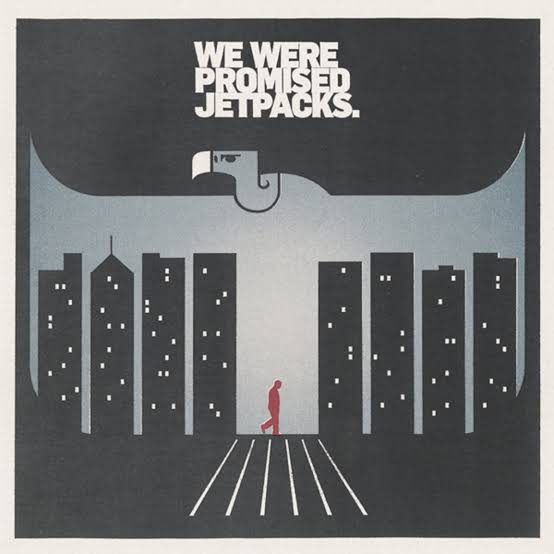
There’s a telling point midway through In the Pit of the Stomach, the latest release from We Were Promised Jetpacks, which best captures the album’s breadth. The Scottish foursome is roaming through the simmering and carefree atmospherics of “Sore Thumb” when two minutes in singer Adam Thompson finally pipes up. In a distant yelp, as if throwing the lyrics at the mic from outside the room, Thompson aches to be heard above the quaint piano, only to yield to an explosion of sound seconds later. It’s enchanting yet borrowed, work from a band with sure potential but one running a bit behind, yet to arrive at a point where it’s heard loud and clear.
The third power in a musical Scot trio including Frightened Rabbit and The Twilight Sad, We Were Promised Jetpacks came into Pit with staunch momentum, stemming from the accolades of 2009′s These Four Walls. And while the band has learned some lessons in editing and restraint since its debut, as Pit doesn’t meander as much as its predecessor, it doesn’t stray too far from it either. WWPJ wallops the listener with walls of guitars, brooding melodies and arena-rock rhythms — and within are moments of pure musical joy. But there’s plenty of filler here too, kind of like the snappy B-roll footage interspersed throughout any reality show seen on Bravo or MTV. It might be pretty to look at, but it does nothing to move the story along.
These songs are easy to spot – all lasting at least five-minutes, which is a minute longer than they should be. The opening ”Circles and Squares,” which comes out of the gates with blitzing drum rolls and guitar guns blazing, is emboldened until it becomes tiresome. This is somewhat understood by the band, as the song shifts to a softer bridge which turns into a rousing, yet typical crescendo. Ordinary on my iTunes, the song is probably amazing in the live setting. “Act On Impulse,” “Boy In The Backseat” and “Pear Tree” all share this same wear, a bloated expansion of musical interludes which nonetheless can charm (as the ending hook of “Act On Impulse” proves).
Yet the band has it in them to be concise with sterling results. “Medicine” is the album’s best work — ranging and constantly inventive, Thompson sings with a quick swagger, his accent giving the lyrics an added wink as the hi-hat and charging guitars assault with gusto. ”Human Error” is relentless in three-minutes of frolic and bluster, with some sly advice for those hearing with a critical bent: “If I was a writer/ then my opinions/ I’d save them for later/ just to see how wrong I can be,” Thompson sings with verve.
OK Adam, good getting to the point – you should try it more often. This is a fine album, but I’d like it more if there were less of it.