September 2005, House of Blues, Orlando, Fla.
When I was a kid, I discovered bands through the radio. I was fortunate to live in a town where the college radio station — WVUM from the University of Miami — played great music (when it wasn’t covering UM baseball games, which it was terrible at). I found out about the Cocteau Twins, Housemartins and Mighty Lemon Drops from VUM, among others, and was always on the hunt to hear about more
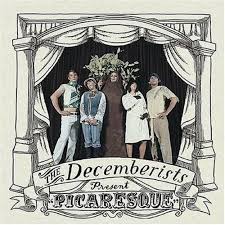
Terrestrial radio nowadays is no place to hear about new music (though satellite radio does pretty well), but it was through old school radio I learned about The Decemberists. NPR did a feature on the band for the release of its album Picaresque, explaining the historical aspects of the band’s lyrics while playing song snippets from the album. Inventive and odd, Picaresque is also melodic and smart and remains a timeless listen (and in the Internet age, NPR would become a great source for finding about upcoming bands).
Third albums, which Picaresque was for The Decemberists, are a telling point for the ultimate longevity of most bands. A good debut can get you the sophomore effort (what’s the adage — you spend a lifetime making your first album and six months making the second), and if you survive the sophomore slump, the third album should see a band using its recent experience to advance and grow. A third album can make music a career for bands, and in some cases elevate the band to new heights — just ask Radiohead (OK Computer), The Clash (London Calling), U2 (War), Def Leppard (Pyromania), Pixies (Doolittle) and Bruce Springsteen (Born To Run). Those are some of the best albums ever made by anyone.
And while Picaresque is no London Calling (for the record, nothing is like London Calling), it’s a fine effort. My wife and I loved the album, and although the band didn’t come down to South Florida (some bands never do make it down there), a two-hour trip to Orlando was easy enough to make.
The band filled the medium-sized stage at the House of Blues, a venue which seemed a bit tiny for this show considering the ample audience. Colin Meloy, the leader of the Portland band, came out and opened with the sizable “California One/Youth” and “Beauty Brigade,” a nine-minute opus from the band’s first album Castaways and Cutouts. The song is not at all a foot-stomper, and it seemed like Meloy was testing the audience to see how engaged they planned to be (perhaps he wanted to ease into the show). The subsequent “Billy Liar” got the crowd more stirred up, while the excellent “16 Military Wives” had the show moving at an elevated clip.
What makes The Decemberists a good live band has a lot to do with its fans — they come in expecting dynamic, quiet tunes and hang on each inflection of Meloy’s voice. Songs such as “Eli, The Barrow Boy” and “Song For Myla Goldberg” don’t work unless the audience shuts the hell up, which they do, only to rear up when the peppy “The Sporting Life” rolls in. Pace is everything in a show, and on this night The Decemberists were up to the challenge. The band also did a nice job incorporating songs from its entire catalog, which you don’t always see at shows.
The set ended with “I Was Meant For The Stage,” a slow burn from Her Majesty, and the band walked off stage to riotous approval. What happened next I can only describe as the best encore I have ever seen.
For the next part, Meloy said, he would need audience participation, noting at a certain point he wanted everyone to scream like they were being swallowed up by a whale. Jenny Conlee then started up the accordion and “The Mariner’s Revenge Song” was off. A nine-minute song about a man’s quest to find and kill the scoundrel who caused his mother’s death, “Mariner’s” is lush and varied, employing mandolin, stand-up bass, floor tom and guitar.
About two-thirds through, just as Meloy sings “And before us grew/The angry jaws of a giant whale,” a massive paper maché whale jaw came roaring on stage, eliciting a mighty roar of laughter and anguish from the crowd. It was a delightful din of literary art meeting music. The song’s end, a fast-paced mix of instruments (which reminds me of the end of Camper Van Beethoven’s “Tania”), wrapped the evening in a nice bow.
What started quietly became a musical frolic by the end — you always want to leave the audience wanting more.