June 1987, Orange Bowl, Miami, Fla.
There’s a guy, he’d be about 31 or 32 now, and back in high school he was a big fan of Staind, or maybe Megadeath (though it could also be Radiohead and Blink 182). He would tell you that in the late ’90s, the height of boy bands and teen-girl pop, he hated that crap with intense disdain — but for one exception. This exception will hit him in unexpected places — walking through the mall with his kids, or at the grocery store. “Baby One More Time” will play, and he’ll sing it, quietly in his head. Begrudgingly he’ll admit Britney Spears stayed with him because her music was there through his high school years, whether he liked it or not.
This is how I feel about Madonna.
If you grew up at any time in the 1980s, Madonna is with you, in some form or another. In high school I was not trying to listen to Madonna — I had R.E.M. and the Clash and Husker Du and The Cure with some AC/DC for good measure. But there was no escaping her.
There was alternative Madonna, followed by pop Madonna, movie star Madonna (with co-star Sean Penn), and then Sex Madonna. And at each juncture there’s a song, a ubiquitous, catchy-ass song that stays with you because, and I don’t mind saying this, Madonna had some great songs. “Like A Virgin” was a joke, the lyrics were stupid — but you listened to it EVERY TIME. Then you learned Niles Rodgers produced it, and how he went about delivering the hook, and you understood. And you cursed that you sang “You’re so fine and you’re mine/I’ll be yours ’till the end of time.”
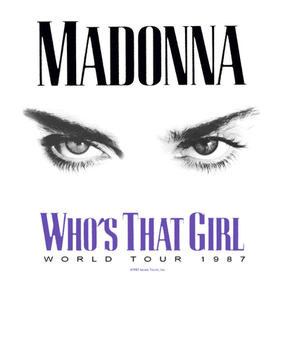
I had some friends, all women, who had an extra ticket to see Madonna for the Who’s That Girl tour at the Orange Bowl. We were all in college by then, and I didn’t have to fake hating Madonna. And besides, I was 19 and there was no way I wasn’t going to turn down an invite by three young women to go anywhere. I was also curious to hear and see what Madonna was like in a live setting.
Unless you’re attending a festival in a field somewhere in rural Tennessee, or California (or wherever people gather in fields to hear music), there’s not much of a chance you’ll see a concert with 70,000 people nowadays. But in the 1980s it was the norm — if a band got big enough, you were certain to see them in a football stadium. The Orange Bowl was a popular destination for me as a teenager, for Dolphins games, Hurricane games, and concerts. This series will discuss some of them, but they include The Police and Bruce Springsteen. In June 1987, Madonna was added to the list.
There’s a whole Wikipedia page dedicated to this tour, something you won’t find for Big Black’s Songs About Fucking tour (also in 1987, which may or may not be ironic). It also confirmed what I easily remembered about the show — it was more of a production than a concert, with the setlist pretty much the same because it’s difficult to change a play each night. She would perform the characters of her music videos during the concert (music videos were popular once), and I think she was singing, but who could tell. Our seats were along the side — if the stage is the end zone, we’re about on the 35-yard line.
Now Who’s That Girl was a soundtrack to a terrible movie, but Madonna also released True Blue the year before, and she grabbed many songs from these two albums. She did a medley of sorts with “Material Girl” and “Like A Virgin,” which if I remember correctly was played with an Egyptian/snake charmer type of groove. There was a bed, that I do remember.
It was, I’ll admit, a fun show because it was different. At this point I was heading to several punk shows, and this was about as far away from slam dancing as you’re apt to find. I would never see her in concert again, but not for lack of appreciating her music — “Like A Prayer” is one of those songs that can be done in a variety of ways (gospel, funk, blues, rock, pop) or can stand alone with an acoustic guitar (a la John Wesley Harding) and be great every time. Ray of Light, from 1998, is excellent, showing Madonna can master a new genre and do it well.
It was a rite of passage for children of the 1980s. Sometimes the things you’re supposed to hate have a way of winning you over.